Course detail
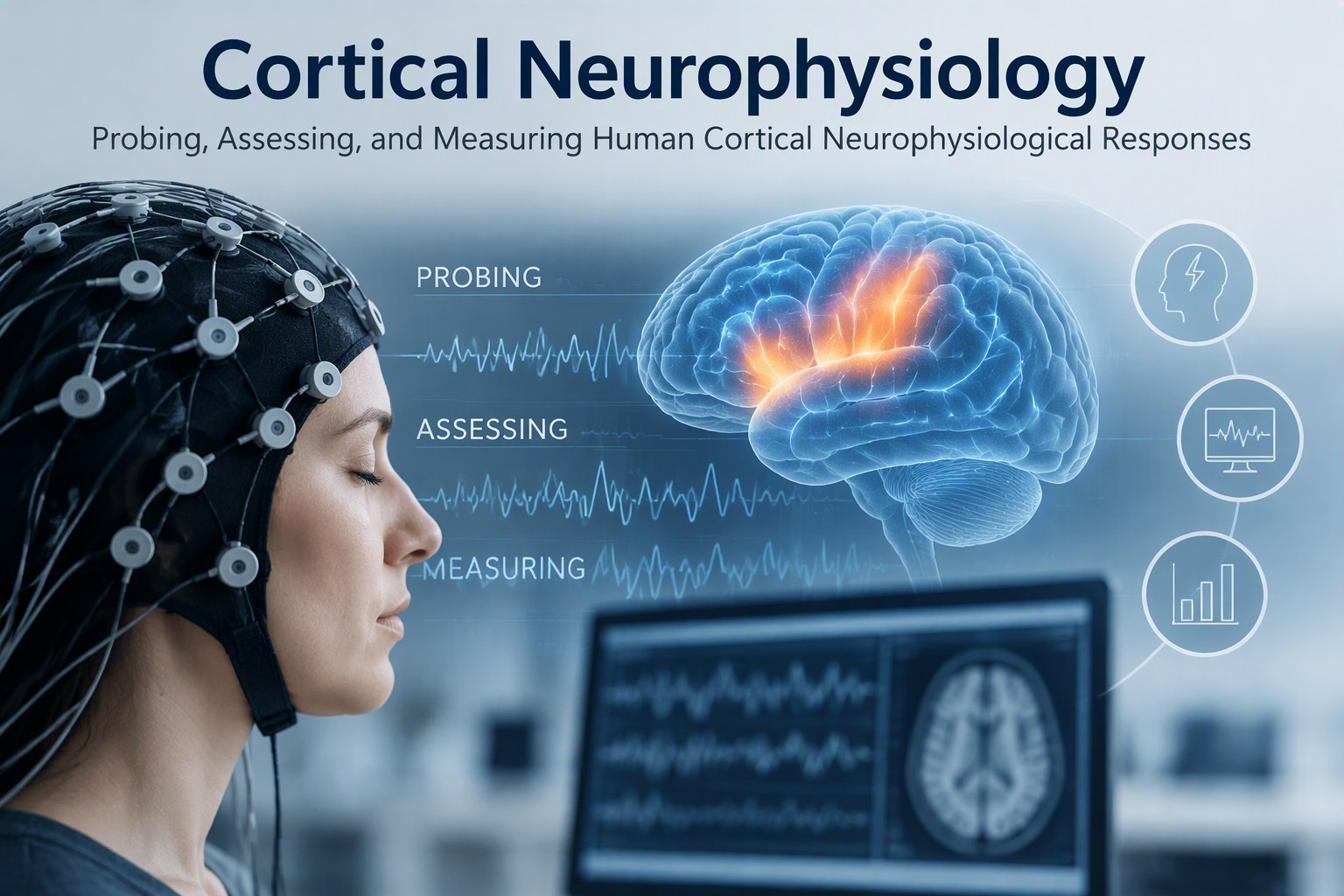 Cortical Neurophysiology: Probing, Assessing, and Measuring Human Cortical Neurophysiological Responses (2027)
Introduction
Welcome to Cortical Neurophysiology: Probing, Assessing, and Measuring Human Cortical Neurophysiological Responses
PhD programme: Biomedical Engineering and Neuroscience
Modern human neuroscience produces an expanding range of measurements of cortical function, from electrophysiological recordings at the scalp to magnetic stimulation of the cortex and structural and functional imaging of the whole brain. Doctoral candidates across health sciences, medicine, biomedical engineering, neuroscience, and psychology routinely encounter these data streams in the course of their own projects; yet rarely receive a structured education in the analytical principles that unite them. The result is a fragmented familiarity in which methods are often used as black boxes, pipelines are inherited without scrutiny, and the conceptual relationship between signal and inference is left implicit. The proposed course addresses this gap by offering a deliberately general grounding in the analysis of human cortical neurophysiological data. Rather than orienting itself around a single technique, disease, or laboratory, the course concentrates on the shared analytical logic that underpins modern measurement of cortical function, namely what is being recorded, what assumptions a pipeline imposes on the data, what can and cannot be inferred from a given metric, and how methodological choices propagate into reported results. Concrete analytical pipelines are used throughout as the vehicle for these principles, ensuring that participants leave with both the conceptual orientation needed to read the multimodal literature critically and the practical literacy required to engage with their own data in a principled manner. The course is therefore broad in scope, transferable across research areas, and explicitly designed to be useful to candidates whose subsequent doctoral work may draw on any combination of EEG, TMS, combined TMS-EEG, or neuroimaging.
Prerequisites:
This course is aimed at PhD students enrolled in Aalborg University's Doctoral Programme in Biomedical Engineering and Neuroscience (BEN) and, in keeping with its deliberately general and method-centred orientation, is equally open to PhD students from other doctoral programmes at AAU (e.g. Health Science and Technology, Clinical Science, Medicine, Molecular Medicine) and, capacity permitting, external PhD students whose ongoing doctoral work involves EEG, TMS, TMS-EEG, or structural/functional neuroimaging data. As with all PhD-level courses accredited within the Doctoral School, participation and the associated ECTS award are reserved for enrolled PhD students; admission of MSc students or other non-PhD participants would need to be arranged separately with the organiser and is not covered by the course's ECTS allocation.
No prior completion of a dedicated EEG, TMS, or neuroimaging methods course is required, since the course is explicitly designed to build the shared analytical foundations from first principles rather than assume prior expertise in any single modality. Participants are, however, expected to hold a basic working knowledge of human neuroanatomy and physiology consistent with their disciplinary background, and a general familiarity with elementary statistics is an advantage for the analytical exercises, though not a formal requirement. Participants should bring their own laptop with the data-analysis software specified by the organiser installed in advance of the course.
Learning objectives:
Teaching methods: Lectures, hands-on data-analysis sessions, and journal club discussions.
Form of evaluation:
In line with standard practice across Aalborg University's PhD-level courses, the course will be assessed on a pass/fail basis; no grade is awarded.
In addition to attendance, each participant will complete a short, applied assignment consolidating the methodological principles covered, either a critical appraisal of a published analytical pipeline in one of the modalities addressed, or a brief oral or poster presentation applying the course's analytical framework to the participant's own (or a provided sample) dataset.
Criteria for assessment:
A pass requires active, documented participation across all confrontation hours, including the lectures, hands-on data-analysis sessions, and journal club discussions that make up the course, since engagement with the material covering each modality (EEG, TMS, TMS-EEG, and neuroimaging) is integral to achieving the stated learning objectives.
The assignment will be assessed by the module leads against the course's defined learning outcomes, and a pass on both the attendance requirement and the assignment is required to obtain the 3.0 ECTS credits.
Literature:
The key literature list will be finalised with the module leads before submission and will combine foundational methodological texts on cortical neurophysiology and signal analysis, contemporary reviews of standard analytical pipelines for EEG, TMS, combined TMS-EEG, and structural and functional MRI, recognised guidelines and reporting standards for each modality, and a small number of empirical exemplars selected for journal club use. The list will be deliberately method-centred rather than disease-centred, in keeping with the general orientation of the course, and will be presented in Vancouver style with DOIs.
Organizer: Professor Daniel Ciampi de Andrade, email: dca@hst.aau.dk
Lecturers:
Professor Daniel Ciampi de Andrade, HST
Professor Jakob Blicher, AAUH
Professor Jens Brøndum Frøkjær, AAUH
Professor Adenauer Casali, UFESP
Professor Silvia Casarotto, University of Milan, Italy
Professor Jean Pascal Lefaucheur, Paris, France
Professor Thomas Graven-Nielsen, HST
Postdoc Margit Midtgaard, HST
Assistant Professor Enrico De Martino, HST
Postdoc Bruno Couto, HST
ECTS: 3.0
Date: 10, 11, 12, 13 May 2027 (08.15-16.15)
Place: Aalborg University, Selma Lagerløfs Vej 249, 9260 Gistrup
Rooms: 10 May: 11.00.033, 11 & 12 May: 12.01.054 (Guest Canteen), 13 May: 11.01.032B
Number of seats: 25
Open for enrolment: 10 January 2027
Deadline for enrolment: 19 April 2027
Important information concerning PhD courses:
There is a no-show fee of DKK 3,000 for each course where the student does not show up. Cancellations are accepted no later than 2 weeks before the start of the course. Registered illness is of course an acceptable reason for not showing up on those days.
Furthermore, all courses open for registration approximately four months before the start of the course.
We cannot ensure any seats before the deadline for enrolment; all participants will be informed after the deadline, approximately 3 weeks before the start of the course.
To attend courses at the Doctoral School in Medicine, Biomedical Science and Technology you must be enrolled as a PhD student.
You may find more information in our FAQ: https://phd.moodle.aau.dk/local/page/faq
For inquiries regarding registration, cancellation or waiting list, please contact the PhD administration at phdcourses@adm.aau.dk When contacting us please state the course title and course period. Thank you.Course currently unavailable to enroll!