Course detail
 Ethnography in practice in interdisciplinary research
Introduction
The course is fully booked! Please sign up at the waiting list.
For inquiries regarding registration, cancellation or waiting list, please contact the PhD administration, phdcourses@adm.aau.dk.
Course description:
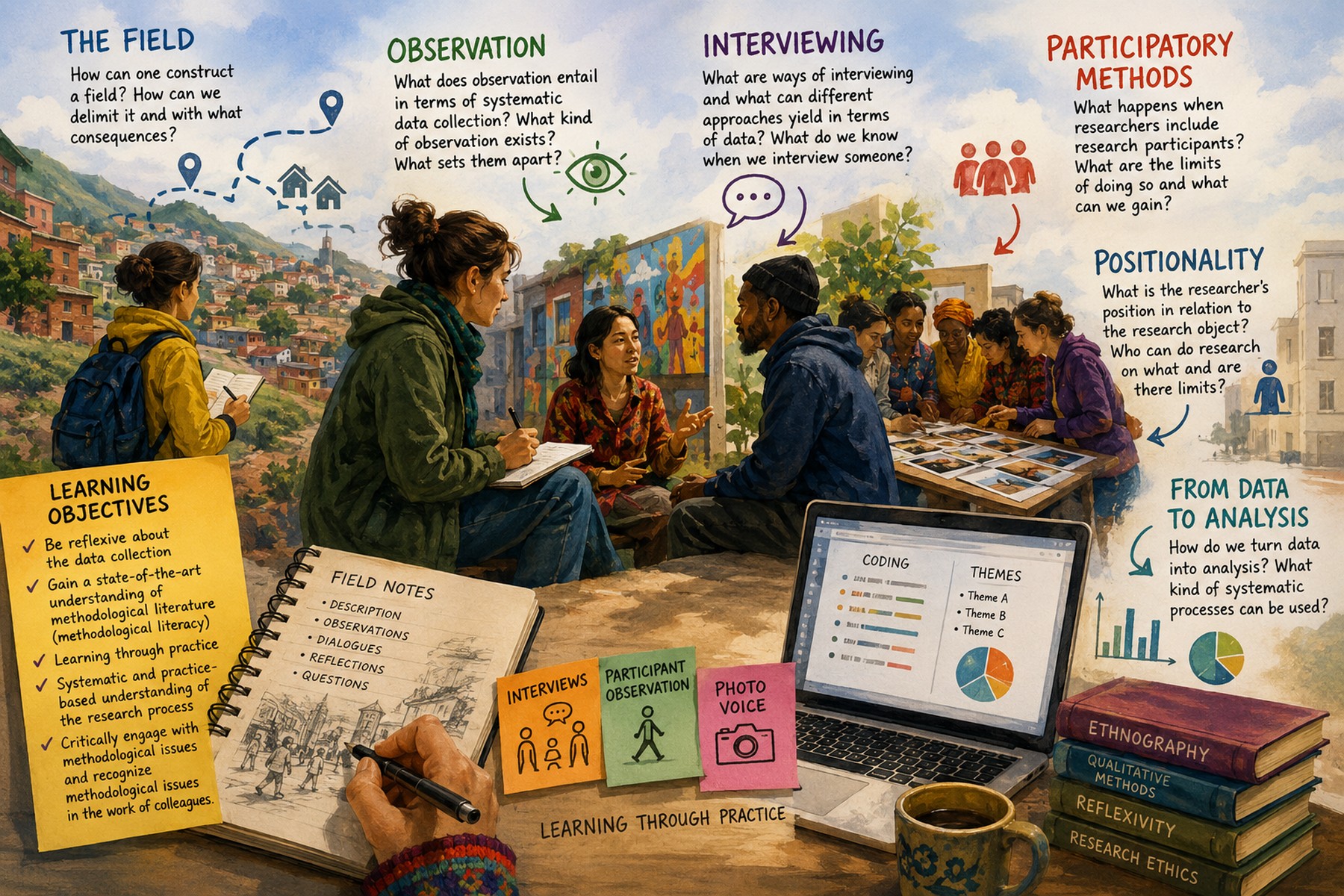
Ethnography has been seen as the domain of anthropologists. However, more and more researchers turn to different versions of ethnography in their fieldwork. This may take the form of participant observation, narrative interviewing, focus group discussions, participatory methods and life histories to mention but a few. While there are courses on interviewing, ethics and similar related topics, there seems to be a distinct lack of courses on the practices of ethnographic research methods. Ethnography is best taught and learnt in practice. However, through a more systematic, sandbox approach, students will be much better prepared to use ethnographic methods, even if their research does not entail long-term anthropological fieldwork. Ethnographic methods can be used productively in a range of different research and data collection processes across different interdisciplinary projects. A semi-structured interview also offers the possibility of observation that can be useful for the research. Attending a meeting in the field – formal or not – also allows us to understand issues in a different way. It is all about observing and sensing in a systematic and reflexive manner. In this way, ethnographic methods and sensibilities are relevant beyond traditional and long-term ethnographic fieldwork. The course can be useful for students as they prepare data collection (ethnographic or not), during fieldwork to get new ideas and after fieldwork to reflect on the practices of fieldwork. It will offer practical tools that will be practiced and discussed during the course. We will explore in practice how to conceptualize a ‘field’ beyond a geographical place; how to engage in reflexive interviewing, for instance narrative interviews; how to observe and write field notes; how to include research participants, and how to turn this data into analysis.
The course runs for four days over two weeks. Each seminar day will be divided into lectures, discussions, reflections, and introductions to exercises in the first half followed by exercises before the next seminar day.
The exercises comprise the following:
- Interviews: Interviewing each other in groups of three, alternating between being interviewer, interviewee and observer.
- Participant observation: Two hours of participant observation on a self-selected field site, documented in field notes, shared before the next seminar.
- Participatory methods: Involve acquaintance/neighbor/family member in a photo voice project as an example of participatory method.
- Students will be asked to carry out and report on the result of the exercises in plenary.
This course will focus on:
- The field: How can one construct a field?? How can we delimit it and with what consequences?
- Observation: What does observation entail in terms of systematic data collection? What kind of observation does exist? What sets them apart?
- Interviewing: What are ways of interviewing and what can different approaches yield in terms of data? What do we know when we interview someone? How can we critically engage with the data we get from the interviews? What is the relation between what people say and the subject matter of the interview – for instance a life history?
- Participatory methods: What happens when researchers include research participants? What are the limits of doing so and what can we gain?
- Positionality: What is the researcher’s position in relation to the research object? Who can do research on what and are there limits?
- From data to analysis: How do we turn data into analysis? What kind of systematic processes can be used?
Learning Objectives (knowledge and abilities):
- Be reflexive about the data collection
- Gain a state-of-the-art understanding of methodological literature (methodological literacy)
- Learning through practice.
- Systematic and practice-based understanding of the research process
- Critically engage with methodological issues and recognize methodological issues in the work of colleagues.
Lecturers: Steffen Bo Jensen, sje@society.aau.dk & Anja Kublitz, kublitz@society.aau.dk
Dates: 17, 20 November 2026, 9-14
24 November 2026, 9-12.30
27 November 2026, 9-15
Place: Online
ECTS: 3
Number of seats: 25
Deadline for enrolment: 27 October 2026
Deadline for paper: 3 November 2026
Important information concerning PhD courses:
There is a no-show fee of DKK 3,000 for each course where the student does not show up. Cancellations are accepted no later than 2 weeks before the start of the course. Registered illness is of course an acceptable reason for not showing up on those days. Furthermore, all courses open for registration approximately four months before start of the course. We cannot ensure any seats before the deadline for enrollment, all participants will be informed after the deadline, approximately 3 weeks before the start of the course. For inquiries regarding registration, cancellation or waiting list, please contact the PhD administration at phdcourses@adm.aau.dk. When contacting us please state the course title and course period. Thank you.
To participate in the course, you must register here.
Enroll